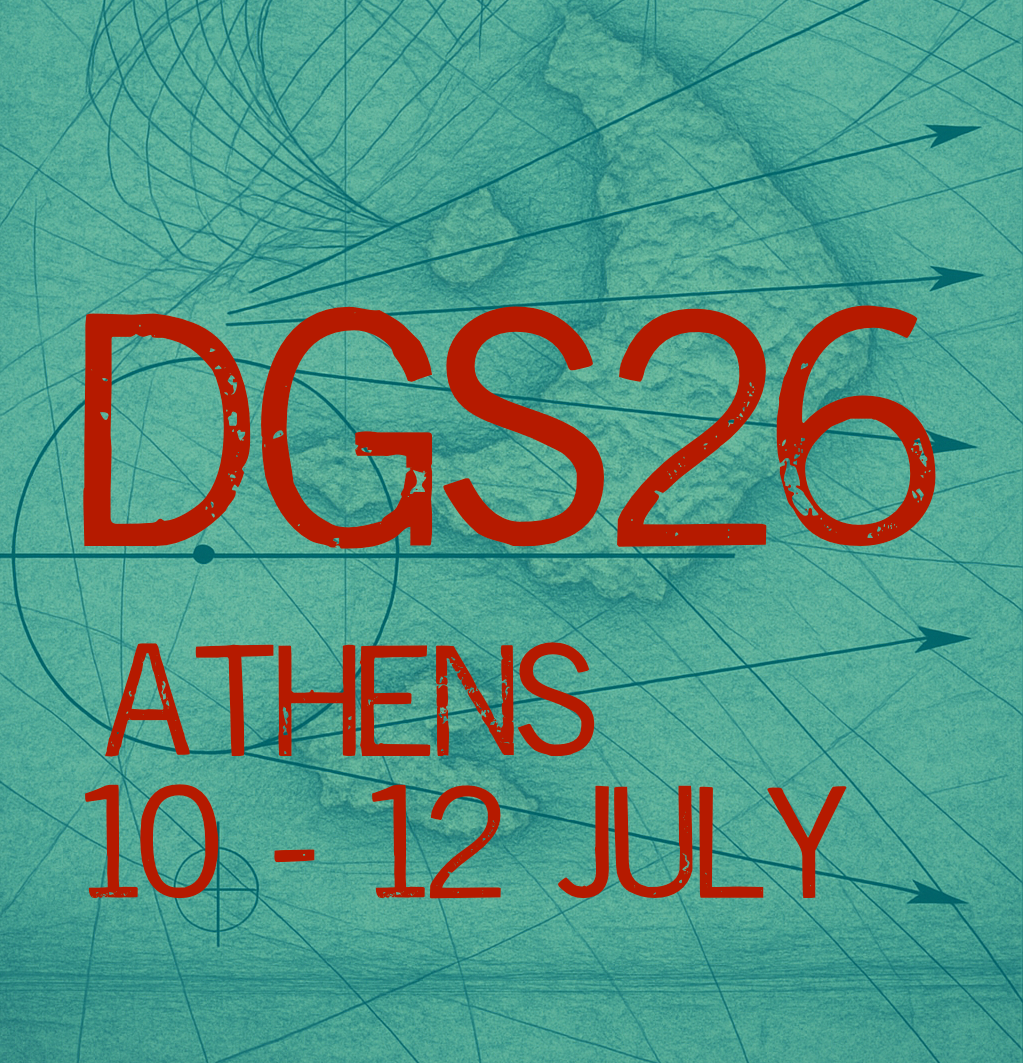
Transversality: Ethics and Politics
https://easychair.org/cfp/dgs2026
Submissions to be sent to: athensdg2026@gmail.com
DEADLINE EXTENDED until March 10th 2026
submissions to be sent at athensdg2026@gmail.com
Deleuze and Guattari Studies Journal
Society of Deleuze and Guattari Studies Athens
Panteion University, dept. of Communication, Media and Culture
University of Thessaly
The 18th Deleuze and Guattari Studies Conference, titled Transversality: Ethics and Politics, will take place July 10–12, 2026, at Panteion University of Social and Political Sciences in Athens, in collaboration with the Department of Communication, Media and Culture.
This year’s conference focuses on the idea of transversality -a concept Deleuze explored in Proust and Signs and Guattari developed further as a way of thinking and acting across boundaries. Transversality challenges binary divisions, fixed hierarchies, and rigid institutional structures. It invites us to think and act collectively in ways that connect rather than separate, and to explore how such connections might reshape ethics, politics, and everyday life.
Instead of treating transversality as an abstract or all-encompassing concept, the conference approaches it as a dynamic movement, one that continually crosses lines, builds relations, and unsettles dominant ways of thinking. Through lectures, discussions, performances, camp, and workshops, participants will explore how transversal thinking can inform theory, art, activism, and collective practice today.
The 18th Deleuze and Guattari Studies conference and camp focuses on the concept of transversality. Deleuze employed the concept of transversality in his work on Proust and the signs, while Guattari explored a potential of it in new directions opening up for political theory and practice through a transversal mode of thought. Instead of pursuing the well-trodden path of addressing an all-encompassing concept, the 18th Deleuze and Guattari conference, aims to approach transversality as a ritornello that addresses unceasingly the intersecting subterranean forces that undermine the binary logic of social and mental segregation as well as the representative functions of hegemonic power relations that pretend to assume the form of reality per se.
Transversality is a practical concept for relational explorations (ethics), the precursors of which, as we see it in these contexts, first applied in difficult clinical and political environments: at Saint-Alban’s postwar psychiatric hospital taking the shape of the ‘Club’ with Fanon and Tosquelles; in colonial and anti-colonial times at Blida-Joinville psychiatric hospital in Algeria with many clubs and the Notre Journal; and at La Borde Clinique with Guattari’s and Ouri’s ‘La grille’.
Such an ethical methodological tool for cartographizing imminent and petrifying power relations as well as immanent desiring forces, it always points to structural political questions and implied political creativity awaiting singularization and individuation. In this regard, Guattari applied this concept’s potential to political organizational matters, such as the distinction between subject-groups and group-subjects, therapeutic practices and institutions, introducing thereby together with Oury the revolutionizing practice of institutional psychotherapy.
Transversality responds, in our time, to the very concrete problem that when we oppose certain power formations, we tend to reproduce these same power formations. One of the main aims of the 18th Deleuze and Guattari conference and camp is to explore ways in which power formations operate today and how transversality responds to them in the multiple levels in which they appear or conceal themselves. As a concept that has been evolved through group dynamics, it challenges the binary opposition between subject and group, patient and analyst, subjective unconscious and institutional repression. As a transformative concept that cuts through the rigid segregations of a global hegemonic society of totalizing repression, transversality addresses all the crucial problems that arise in the interconnection and disjunction of ethics and politics, society and culture. Through its autopoetic, enunciative, transmonadic and transitive character, it introduces a plane of immanence which cuts across heterogeneous and unconnected levels. It disrupts a horizontal sense of sameness and diversity, while, at the same time, it challenges vertical hierarchies, towards collective unconscious deliberating desiring necessities.
One of the main aims of the 18th Deleuze and Guattari Camp and Conference will be to address the relationship between transversality, nomadic thought and the different types of war machines and power formations, as they arise in the critical time of our present marked by the induced feeling of powerlessness towards the most horrific and tangible expressions of hegemonic power in the systematic extinction of entire populations and together with them the paradigmatic extinction of the very notion of resistance to the totalizing repressive machine of late capitalism.
The 18th Deleuze and Guattari conference welcomes contributions that challenge rigid structures and hegemonic vertical relations, in the various disciplines and in the interconnection between disciplines in which they might appear. Some of the themes that might be explored can be the following, always keeping in mind that this list is not exhaustive:
The impact of transversality on group-subjects dynamics.
The employment of the concept of transversality in clinical practice, institutional psychotherapy, psychoanalysis, psychotherapy
Transversals between signs, symptoms, and creativity in art and aesthetics.
The actual and virtual relationships between transversality and other DG concepts
Transversality as a new way to think gender, social inequality, as well as the impact of institutions and power relations upon a non-subjectivised unconscious.
Transversality and new types of resistance in politics, ethics, art.
The repercussions of autopoetic, self-organising dynamics in the ways in which we perceive political activism and revolutionary action.
Transversals internal and in between Biology, Art, Technology, and Society
Philosophical proximities of DG’s function of transversality with other philosophies
Ecosophical and geopolitical transversalities
Transversalities between ethics of humans, animals, processes and objects
Transversalities between political pasts, presents and futures
 dgs2026